

A Ducted AC Dealer and Ducted AC Supplier Built Around Concealed Comfort
We are a UAE air conditioning company that specialises in one discipline: concealed ducted air conditioning. Ducted AC supply, ducted AC installation, commissioning and long-term service are what our engineers and crews do every working day — not a sideline to residential split units.
- Ducted specialists, not generalists
- In-house installation crews
- Genuine regional equipment only
Three things clients come to us for, repeatedly.
-
Ducted AC SupplyLow, medium and high static concealed units from stocked regional stock
-
Ducted AC InstallationDuct design, routing, grilles, drainage, commissioning
-
Ducted AC ServiceCoil cleaning, drainage checks and maintenance contracts
Who We Are: A Ducted AC Dealer in the UAE
An air conditioning company organised around one system type, because that is what concealed comfort actually demands.
We are an established with 25 years of experienced ducted AC dealer based in the United Arab Emirates, supplying and installing concealed ducted air conditioning for villas, apartments, offices, clinics, restaurants and retail spaces. Our business was built deliberately around ducted systems because ducted work rewards specialisation in a way that simpler installations do not.
A wall-mounted split unit arrives as a complete product. A ducted system does not. It begins as an indoor unit with a static pressure rating and becomes a working system only through duct sizing, routing, insulation, grille selection, return air design, condensate drainage and commissioning. Every one of those steps can be done well or badly, and the difference is invisible once the ceiling is closed. That is the reason we concentrate on this discipline rather than spreading across everything.
As a ducted AC supplier, we hold genuine regional equipment with valid manufacturer documentation, and we size it against delivered capacity at UAE design conditions rather than nominal catalogue figures. As installers, we run our own crews rather than subcontracting the work that determines whether a system performs. And as a service provider, we maintain the systems we install, which keeps us accountable for the outcome long after the handover certificate is signed.
Our clients are a mixture of private villa owners, landlords and building managers, fit-out contractors, interior designers and MEP consultants. What they have in common is a requirement that the cooling equipment should not be visible, should distribute air evenly across a space, and should still be performing to specification several summers from now. That is precisely the problem a properly engineered ducted system solves, and it is the only problem we have organised our business to solve.
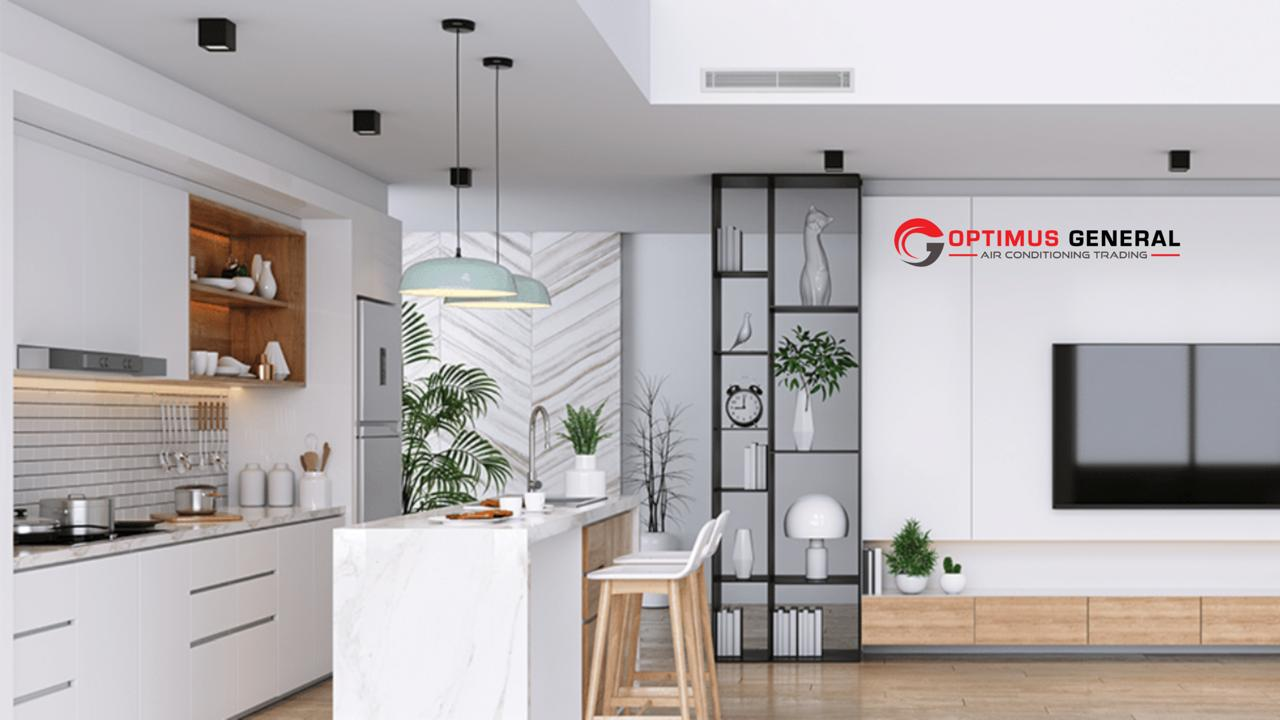 Ducted AC Specialists
Concealed By Design
We exist for projects where equipment must not be seen. Ducted AC keeps walls and ceilings clear, so joinery, lighting design and interiors proceed without hardware interrupting them.
Even Air Distribution
A single ducted unit serving a large space through multiple grilles distributes air far more evenly than a wall unit blowing from one end of the room, which is why open-plan villas and majlis rooms suit it so well.
Engineered, Then Installed
Static pressure, duct velocity, return air and drainage are resolved on paper first. Decisions taken at design stage are the ones that are impossible to correct after the ceiling is finished.
How We Became a Ducted AC Supplier in the UAE
The business began in [YEAR] with straightforward air conditioning supply and installation work across Dubai and Sharjah. Like most companies starting out, the early portfolio was dominated by wall-mounted split units: fast jobs, simple pipework, and an obvious result at the end of the day. What changed the direction of the company was the number of repeat enquiries that came back asking for something the splits could not provide.
Villa owners wanted cooled rooms without a wall unit above every doorway. Restaurant and clinic operators wanted the equipment out of sight entirely. Fit-out contractors wanted to hand over interiors that looked finished rather than punctuated by white plastic casings. Interior designers asked, reasonably, why the cooling system had to dictate where furniture could go. Every one of those conversations pointed to the same answer, and that answer was concealed ducted air conditioning.
Moving into ducted work properly meant investing in capability that retail supply does not require. We brought duct design and static pressure calculation in-house instead of leaving it to whoever happened to be on site. We built installation crews who understand that a ducted system is won or lost on return air sizing, sealed joints, insulation continuity and drainage fall — the details nobody sees and everybody eventually feels. We added the testing equipment to pressure test and commission a system rather than simply switching it on.
That shift shaped the company we are today. We handle a defined scope across the ducted AC UAE market: supply of genuine regional equipment, ducted AC installation by our own teams, and the maintenance that keeps those systems inside their design envelope through years of dust, humidity and 45°C summers. We still supply split and VRF systems where they are the correct answer, because recommending the wrong system type to protect a specialism would be poor engineering, but ducted work is the core of what we do and the reason clients contact us.
Growth built on repeat work, not advertising
A large share of our current ducted AC projects arrive through referrals from clients, contractors, designers and facility managers we have already worked with. That pattern is not accidental and it is not a marketing strategy; it is the practical consequence of doing concealed work to a standard that survives inspection and, more importantly, survives five years of operation. A ducted installation that performs as designed generates the next project. One that drips onto a ceiling, whistles at night or fails to cool the far end of a majlis does the opposite, and word travels quickly in the Emirates.
We have deliberately kept the business at a size where senior engineering attention reaches every project. A ducted system specified and installed under that discipline costs no more than one that is not, and it removes the two problems that consume the most money in this market: systems that never worked as designed, and systems that were never designed at all.
Ducted AC Supply, Installation and Service
Three connected services that cover a ducted system from first drawing to its tenth summer of operation.
Ducted AC supply
We supply concealed ducted indoor units and matched outdoor condensing units with valid regional documentation, warranty registration and the technical data a consultant or landlord’s engineer will ask to review. Selection is based on the delivered capacity a unit achieves at UAE design conditions, together with the static pressure your duct network actually produces — not on the nominal figure printed on a brochure.
Equipment can be supplied on its own for contractors who install with their own teams, or as part of a complete supply-and-install package. Either way you receive the same selection support, the same documentation and the same access to technical advice on piping, drainage and commissioning.
Ducted AC installation
Installation is carried out by our own crews, not subcontracted labour. That matters more on ducted work than on any other system type, because the quality that determines performance is concentrated in work that disappears behind plasterboard: duct sizing and velocity, insulation continuity, sealed joints, return air paths, condensate fall and secondary containment, and framed service access.
Our installation scope covers the indoor unit position and support, ductwork and acoustic lining, supply and return grilles or linear diffusers, drainage with fall and safe discharge, electrical connection, controls, and full commissioning with documented start-up readings. Where ceilings are being built by others, we coordinate directly with the ceiling and MEP contractor so the ducted installation does not become the reason a programme slips.
Ducted AC service and maintenance
A concealed system cannot be inspected by glancing at it. Coils sit above a ceiling, filters are behind an access panel, and the condensate drain runs where nobody looks until water appears on a wall. Regular maintenance on a ducted system is therefore not optional housekeeping; it is the only way to know that the equipment is still operating as designed.
We provide scheduled maintenance covering filter and coil cleaning, drainage and pump checks where fitted, electrical and control inspection, refrigerant pressure verification and airflow measurement. Contracts are available quarterly for continuously running commercial systems and half-yearly for residential installations, with priority attendance for breakdowns and a written condition report per visit.
Repairs, upgrades and system replacement
Ducted systems are long-life assets and are frequently worth repairing rather than replacing. When a ducted unit stops cooling, the cause is often a refrigerant leak at a joint, a failed capacitor, a blocked drain or a coil that has never been cleaned — all correctable at a fraction of replacement cost. We diagnose before we quote and tell you honestly when replacement genuinely is the better long-term decision.
Where replacement is required, we assess whether the existing duct network and pipework can be reused. On many villa and office refurbishments the ducting remains serviceable, which allows a full equipment modernisation at a sensible cost. Where the ducting has been damaged by water, collapsed or was undersized from the outset, we say so and quote the correction rather than quietly connecting new equipment to a network that will never perform.
Why Ducted AC Suits the UAE Better Than Wall Units in Many Spaces
Ducted air conditioning is not automatically the right choice for every room, and any supplier who claims otherwise is selling rather than advising. It is, however, clearly the better engineering answer for a specific set of conditions that appear constantly in the Emirates.
Aesthetics and interior design. The most obvious advantage is that you cannot see the system. A ducted indoor unit sits above the ceiling and delivers air through a slim linear grille or discreet diffuser. In a villa majlis, a penthouse living room, a restaurant or a boutique retail unit, that means no wall unit dictating the position of furniture, no cabling on the facade and no equipment interrupting a design scheme. Designers specify it precisely because it removes a constraint they would otherwise have to design around.
Even temperature across large spaces. A wall-mounted unit cools the area nearest to it and lets the far corner drift. A single ducted unit feeding several supply points distributes air across the whole footprint, so a long open-plan living area or a wide office floor holds a consistent temperature rather than a gradient. For rooms over roughly thirty square metres, or anything open-plan, this difference is immediately noticeable on a hot day.
Multiple rooms from one unit. A ducted unit can serve several adjacent spaces through individual ducts and grilles. A bedroom wing with three rooms and a corridor, for example, can be cooled from a single concealed unit rather than three separate wall units, which reduces visible equipment and consolidates the serviceable components into one accessible location.
Zoning and control. Where rooms are used at different times — a guest wing, a study, a formal sitting room — motorised dampers and separate room thermostats let a ducted system deliver cooling only where it is needed. That reduces waste in exactly the way a bank of permanently visible units cannot.
Condensation and humidity control. In a ducted system the evaporator coil sits above a properly drained tray with a fall to a discharge point, usually with a secondary containment and often a float switch. In coastal UAE humidity this arrangement handles condensate volume more robustly than wall units discharging through a wall sleeve, which is one reason ducted installations suffer fewer water-damage complaints over their lifetime when they are installed correctly.
When a ducted system is not the right answer
Ducted AC needs two things above all: a usable ceiling void or bulkhead, and the budget to do the ductwork properly. Where there is genuinely no ceiling space, or where the requirement is a single small room with no design constraint, a wall-mounted split is faster, cheaper and every bit as effective. We will say so directly. Recommending a ducted system where a split unit serves the space better would make the first invoice look larger and the relationship shorter.
The cases where ducted work consistently justifies itself are villas and apartments under refurbishment, new-build residential projects, offices and clinics, hospitality fit-outs, and any interior where the client has decided that visible cooling equipment is not acceptable. In those situations the ducted AC installation cost is not a premium for appearance alone; it is what delivers even airflow, hidden services and a single controlled system across several rooms at once.
Ducted AC Systems We Supply
Concealed indoor units across the static pressure range, matched to outdoor condensing units, from residential duties to light commercial.
Ducted indoor units are not interchangeable. They are built at different external static pressure levels, and the correct choice is the one that matches the duct network you are actually installing. Too low and the air never reaches the furthest grille; too high and you pay for fan energy and tolerance of avoidable noise. This is the single most consequential selection decision on a ducted job, which is why we ask for the duct layout before we quote.
Low static units suit short, simple runs — a single room, a small corridor ceiling, or a bedroom or two served from one compact unit. They are compact, quiet and inexpensive to install, and they represent the majority of residential ducted work we carry out in apartments and smaller villas.
Medium and high static units are specified where duct runs are longer, where several diffusers hang off one unit, or where the duct passes through plant or roof spaces that add resistance. Adjustable static pressure up to around 150 Pa covers most light commercial installations, including offices, clinics and hospitality spaces with multiple branches and acoustic lining in the duct path.
The main platforms we work with are the concealed ducted indoor ranges from Mitsubishi Electric and Mitsubishi Heavy Industries. Mitsubishi Electric supplies the SEZ low-static and PEAD medium-static concealed indoor units, and its City Multi platform brings ducted units into VRF networks where a building needs many zones from one outdoor bank. Mitsubishi Heavy Industries provides the FD packaged ducted range and the KXZ VRF multi-system, which is designed to connect a high number of indoor units to a single condensing bank. We also supply ducted equipment from other reputable manufacturers where a project specification calls for it, so the correct system can be selected on merit rather than restricted to one badge.
Capacity planning follows the same discipline regardless of platform. As a working rule, one ton of cooling — 12,000 BTU per hour, roughly 3.5 kW — covers about ten square metres of standard residential space, and that figure rises steeply for unshaded glazing, high ceilings, top-floor rooms and any space required to introduce fresh air. Ducted systems are commonly selected from around one ton upward for a single concealed unit, with larger three-phase equipment for whole floors of villas, retail units and commercial suites. Every selection we issue is checked against the rooms it will actually serve.
Ducted AC Installation: How We Work
A ducted system is won or lost before the ceiling closes. These are the stages every job passes through, from a single concealed unit to a full floor.
Survey & Requirements
We measure the actual spaces, check ceiling void depth along the intended route, identify feasible air paths and confirm where condensate can discharge by gravity. Rooftop and outdoor positions are verified, along with electrical provision and access for future service.
Duct Design & Selection
Room-by-room heat load, indoor unit selection at the correct external static pressure, duct sizing and routing, grille and diffuser positioning, return air arrangement and drainage layout — resolved on paper before a single item is ordered.
Installation
Unit positioning and support, sealed and insulated ductwork, acoustic lining where required, grilles, drainage with fall and secondary containment, control wiring and access panels framed so the unit remains serviceable for life.
Testing & Handover
Nitrogen pressure testing, vacuum evacuation, correct refrigerant charge, airflow measurement at each grille, condensate flow test and control configuration, with documented readings and a walkthrough of the system before handover.
Coordination with ceiling, electrical and fit-out trades
Ducted work is inherently a coordination exercise. The indoor unit competes for the same ceiling void as lighting, sprinklers, cable trays and drainage. If the ducted installation is sequenced last, someone is forced to compromise, and it is usually the duct that gives way — flattened, rerouted through a tighter path, or run without adequate insulation. The result cools badly and nobody can see why.
We therefore prefer to be engaged while ceilings are still open and services are being set out. On projects where we are appointed early, we issue duct routing and unit position drawings so the other trades can work around the system rather than through it. Where we are appointed late, we survey what space genuinely remains and design within it, which sometimes means recommending a shallower unit or an additional small unit instead of forcing one oversized unit through an impossible route.
Working in occupied buildings
A significant share of our ducted AC installation work happens in buildings that remain in use: apartments being refurbished around their owners, offices upgraded over a weekend, clinics that cannot close for a week. That changes the method as much as the schedule. We plan work in phases, protect occupied areas, control dust and noise, maintain containment of refrigerant and debris, and sequence the noisiest operations into agreed hours. Where a property must retain cooling throughout, we stage the changeover so no room is left without air conditioning during the programme.
Ducted AC Installation Standards and Commissioning
Standards are only meaningful if they are applied on every job, including the small ones. A single concealed unit serving a bedroom deserves the same discipline as a floor of ducted equipment, because the failure mode is identical: an installation that holds temperature in its first year and cannot keep up in its third.
The practices below are not optional on our projects. They are what we consider the minimum standard for a ducted system, and they are the reason we can offer maintenance contracts with confidence rather than treating every visit as a discovery.
 Genuine Equipment
- Static pressure matched to the built duct run — verified rather than assumed, because this single figure governs airflow at every grille for the life of the system.
- Duct velocity kept within sensible limits and acoustic lining specified where the route passes close to bedrooms or meeting rooms, so the system cannot be heard before it can be felt.
- Insulation continuous and joints sealed. Duct running through an uncooled void without adequate insulation loses cooling before it arrives, and leaking joints draw hot attic air straight into the supply.
- Return air properly sized. Undersized returns starve the coil, raise noise and reduce delivered capacity — a common defect on systems installed by those who only size the supply side.
- Condensate drained by gravity with a fall, with secondary containment where the route demands it and a float switch as protection against overflow.
- Service access framed at installation stage, sized so a technician can reach the unit, the coil and the drain for cleaning without dismantling a finished ceiling.
- Pressure test, evacuation and weighed charge. Refrigerant is charged to specification rather than judged by gauge feel, and the commissioning readings are recorded and handed over.
- Airflow measured at each grille at handover, which is the practical proof that the duct design and the unit selection were correct.
| Application | Typical static pressure duty | Key design consideration |
|---|---|---|
| Bedroom or small apartment | Low static | Short direct run, low noise at night, access panel in a corridor ceiling |
| Villa living area or majlis | Low to medium static | Multiple supply diffusers, even distribution across a large open volume |
| Villa bedroom wing | Medium static | Several rooms from one unit, zoning via dampers and separate thermostats |
| Office or clinic floor | Medium to high static | Long runs, acoustic lining, fresh-air provision added to the load |
| Restaurant or retail unit | Medium to high static | High internal and occupancy load, kitchen extract coordination |
| Refurbishment with tight void | Low static, shallow unit | Reusing sound existing ducting, maximising what the available void allows |
Who We Work With
Different sectors, the same underlying requirement: concealed cooling that performs and stays serviceable.
Villas & Apartments
Private owners, landlords and tenants upgrading from visible wall units to concealed ducted systems, or replacing ageing ducted equipment while reusing sound ductwork. We work around occupied homes and phase the changeover so no room loses cooling.
Offices & Clinics
Fit-outs and refurbishments where ceiling void must be shared with lighting and services, and where acoustic performance and even airflow across partitioned spaces matter as much as capacity. Fresh-air load is calculated rather than omitted.
Hospitality & Retail
Restaurants, cafes, salons, showrooms and boutiques where the equipment must be invisible and internal loads from occupancy, cooking and lighting dominate the calculation. Ducting is coordinated with kitchen extract and interior joinery.
Contractors, Designers & Consultants
Fit-out companies, interior designers and MEP consultants who need equipment supply, selection support and ducted installation to a programme. We respond in the structure you specify, issue duct routing drawings where appointed early enough, and phase deliveries to match site progress.
Facility Management & Landlords
Building managers and property owners responsible for multiple ducted systems across a portfolio. Maintenance contracts, condition reporting per unit and priority breakdown attendance are structured around the obligation a facility manager actually carries, not around a supplier’s convenience.
Ducted AC UAE: Where We Supply and Install
Supply, ducted AC installation and maintenance across the Emirates, with the same equipment, documentation and technical support regardless of location.
Our ducted AC UAE coverage extends across all seven Emirates. The four markets below account for the great majority of our concealed installation work, and each presents a different set of practical constraints that we have learned to plan around rather than discover on site.
Dubai is our largest market by volume, and the most varied. Studio and apartment refurbishments need compact low-static units fitted into tight ceilings; villas across Jumeirah, Mirdif and the Arabian Ranches corridor need multi-room ducted systems with zoning; commercial units in Business Bay, Deira and Dubai Investment Park need larger equipment with fresh-air provision calculated into the load. Building management approval for outdoor unit positions is frequently the longest part of a Dubai job, so we prepare the technical submission early.
Abu Dhabi brings larger volumes, longer duct runs and sites that sit well outside the city. Compound villas in Khalifa City and Al Reef, clinics and offices on the island and schools further inland all demand equipment with more headroom, and outdoor positions facing sustained high ambient temperatures call for tropicalised units with anti-corrosion coil treatment rather than standard equipment. Deliveries on large compounds are phased so units arrive as each property reaches installation stage.
Sharjah is dominated by established mid-rise residential buildings where ceiling voids are tighter and existing equipment has often reached the end of its working life. Much of our work there is either replacing ageing ducted plant while retaining ductwork that passes inspection, or converting a flat from multiple wall units to a single concealed ducted system where the corridor void allows it.
Ajman mixes residential towers with substantial industrial and warehousing zones. Apartment work needs tidy, fast concealed installation with minimal disruption to neighbouring units, while staff accommodation and labour housing more often suit multi-split or ducted configurations that reduce the number of outdoor units on the facade while keeping rooms independently controllable.
Beyond those four, we supply and support projects in Ras Al Khaimah, Fujairah, Umm Al Quwain and Al Ain, including phased delivery and remote selection advice so a site outside the main cities is not disadvantaged by geography.
| Emirate | Typical ducted work | Practical consideration |
|---|---|---|
| Dubai | Apartment conversions, villa systems, office and retail fit-outs | Building management NOC and outdoor unit positioning |
| Abu Dhabi | Compound villas, clinics, offices, schools, industrial facilities | Longer runs, higher ambient exposure, remote site logistics |
| Sharjah | Flat conversions, replacement of ageing ducted plant | Tight ceiling voids, ductwork reuse assessment |
| Ajman | Residential towers, staff accommodation, warehousing offices | Facade management and independent room control |
| RAK, Fujairah, UAQ, Al Ain | Project supply, hospitality, schools, residential developments | Phased delivery and remote technical support |
Our Team and Technical Capability
Concealed air conditioning is unforgiving of inexperience. The work that decides whether a ducted system performs happens inside a ceiling void and cannot be inspected afterwards without opening it up, so the people doing that work carry the whole outcome of the project with them.
Our engineering side handles heat load calculation, equipment selection, static pressure matching, duct sizing and drainage design, and prepares the documentation that consultants and landlords ask to review. Our installation crews work on ducted systems continuously rather than occasionally, which means the details that cause most failures — an unsealed joint, a compressed duct, an undersized return, a condensate run without fall — are handled as routine practice rather than recalled from a training course.
We also keep our technical support available to others. Contractors and consultants buying equipment from us can ask for selection checks on static pressure, copper line length and elevation limits, refrigerant charge calculation and control configuration. Catching a mismatch on paper costs nothing; discovering it after the ceiling is closed costs a great deal.
Training, tooling and refrigerant handling
Ducted systems depend on proper evacuation and charging far more than wall units do, because refrigerant volumes are larger and pipe networks longer. Our teams work with vacuum pumps, manifold gauges, leak detection equipment, airflow measuring instruments and recovery equipment suitable for the refrigerants in current equipment. Refrigerant is handled and recovered responsibly, and old equipment removed from a replacement project is disposed of rather than abandoned on site.
Installation Team
Warranty, Service and Aftercare
Equipment supplied through us carries manufacturer warranty, and the documentation is issued in your name at handover rather than retained by us. Compressor cover and parts cover are stated separately in the warranty terms, and both are worth reading before you buy rather than after something fails. Our own installation workmanship is warranted as well, which matters because a substantial share of early ducted system failures trace back to installation rather than to the equipment itself.
After handover, the maintenance relationship is what determines whether the system is still performing to specification in five years. Dust is the dominant issue in this climate. It loads filters, mats condenser coils and raises condensing pressure, which simultaneously increases power consumption and reduces delivered cooling. By the time an owner notices that a ducted system has “lost its cooling”, the cause is frequently nothing more than two unserviced summers of accumulated dust.
What a maintenance visit actually involves
Our scheduled visits cover filter cleaning, evaporator and condenser coil cleaning, condensate tray and drain flushing with a flow test, pump inspection where fitted, electrical and control checks including contactor and capacitor condition, refrigerant pressure verification, and airflow measurement at the grilles to confirm the system is still delivering what it was designed to deliver. Each visit produces a written condition report, so a landlord or facility manager has a documented maintenance history rather than a verbal assurance.
Maintenance contracts are available on a half-yearly schedule for residential ducted systems and quarterly for commercial or continuously running equipment, with priority attendance for breakdowns. Contracts suit any building running more than a handful of concealed units, because scheduled servicing costs considerably less than reactive repair and keeps running cost close to where it was designed to be.
Breakdowns and repairs
Not every problem requires new equipment. A ducted system that has stopped cooling is often losing refrigerant at a joint, or has a failed capacitor, a blocked drain causing the unit to protect itself, a stuck zone damper or a coil that has never been cleaned — all repairable at a fraction of replacement cost. Where refrigerant loss is the cause, the correct remedy is to locate and repair the leak and then charge the system to its specified weight, not to top it up each season. Repeated top-ups conceal a leak, waste money and eventually destroy the compressor.
Why Clients Choose Us as Their Ducted AC Supplier
A ducted project is judged years after it is handed over. These are the commitments that decide how that judgement goes.
We Only Do Concealed Work Properly
Ducted systems are our specialism rather than one line among many, which means selection, duct design and installation are handled by people who work on concealed systems continuously. As a focused ducted AC dealer, we carry the experience of what fails above ceilings and design to avoid it.
Diagnosis Before Quotation
We inspect the space, the void, the drainage path and any existing equipment before pricing anything. Where a wall-mounted split would genuinely serve you better than a ducted system, we will say so — an honest recommendation costs less than a system that was never the right answer.
Genuine Equipment With Valid Warranty
Equipment supplied through us is genuine regional stock with documentation issued in your name. Grey-import units may look identical and still be rated for a climate that does not exist here, with warranty cover that cannot be exercised locally.
Duct Design Treated as Engineering
Static pressure, duct velocity, return air sizing, insulation continuity and drainage are resolved on paper. These are the decisions that determine whether the furthest grille receives the airflow it should, and they cannot be corrected once the ceiling is finished.
Quotations That State the Scope
Every proposal lists the equipment platform, the capacity selected, the duct and grille scope, drainage arrangement, controls and what is excluded. Two quotes for the same system can differ substantially because of what was left out, and a low figure that omits the ducting is not a low figure.
One Number, One Accountable Team
Call 054 737 9588 and you reach the team that specified, installed and now services your system. No call centre, no ticket queue, and no dispute about whether a fault is the equipment’s responsibility or the installer’s — because both are ours.
Ducted AC: Frequently Asked Questions
The questions owners, contractors and facility managers ask us most often about concealed ducted air conditioning in the UAE.
What is a ducted AC system and how does it differ from a split AC?
A ducted AC system conceals the indoor unit above the ceiling or inside a bulkhead and delivers cooled air through insulated ductwork to supply grilles or linear diffusers in each space. A split AC, by contrast, mounts its indoor unit visibly on the wall and blows air directly into the room from that single point. Ducted systems are chosen where equipment must not be seen and where air needs to be distributed evenly across a large or multi-room area, while splits are simpler and cheaper to install for a single room.
Are you an authorised ducted AC dealer in the UAE?
We are an established ducted AC dealer operating across the United Arab Emirates, supplying genuine regional equipment with documentation issued in the client’s name. We work with the main commercial platforms, including the Mitsubishi Electric and Mitsubishi Heavy Industries concealed ducted ranges, and we install and service the systems we supply rather than passing that responsibility to a third party.
How much does ducted AC installation cost in the UAE?
Cost depends on the number of concealed units, the length and complexity of the duct route, how many supply and return grilles are needed, whether access panels must be framed, the drainage path, and whether existing ductwork can be reused. We deliberately do not publish a single headline figure because it would mislead. Call 054 737 9588 with your room sizes or send a floor plan, and we will issue a firm written quotation that separates equipment, ducting materials and labour.
How long does ducted AC installation take?
A single concealed unit serving one or two rooms is typically completed within a few days including ductwork, grilles and commissioning. A villa-wide ducted system usually runs to one or two weeks, depending on the number of units and how much ceiling work is involved. On commercial fit-outs the ducted package is programmed around the ceiling and MEP sequence rather than a fixed duration, and we confirm the expected programme in writing before work begins.
Can ducted AC be installed in an existing apartment or villa?
Yes, and much of our work is exactly that. A shallow low-static ducted unit can often be run along a corridor ceiling or above a bathroom to serve adjacent rooms, which is how apartments usually convert from visible wall units. In villas we frequently replace only the indoor and outdoor units while reusing ductwork that passes inspection, which keeps the cost of modernising a large property sensible. Where there is no usable ceiling void, we will tell you honestly rather than force a system in.
What ceiling void depth does a ducted system require?
It depends entirely on the unit and the duct route. Compact low-static concealed units need relatively little depth, while medium and high-static units feeding multiple duct branches require considerably more, and the route must clear the lighting, sprinklers and cable trays sharing the same void. This is why we measure the actual void along the intended path during the survey rather than quoting from a catalogue dimension, and why a plan-stage review usually avoids surprises later.
How often should a ducted AC system be serviced in the UAE?
Filters should be cleaned monthly through peak summer and every two to three months outside it, because dust loading is the fastest way to lose performance in this climate. A professional service covering coil cleaning, drainage checks, electrical inspection and airflow measurement is best carried out twice a year for residential systems and quarterly for commercial or continuously running equipment, with coastal and dusty locations at the more frequent end of that range.
Can existing ductwork be reused when replacing a ducted air conditioner?
Sometimes, and only after inspection. Ducting can be reused when the insulation is still intact, the sizing suits the replacement unit’s airflow, the joints are sealed and the route has not been damaged by water or collapsed. Reusing sound ductwork saves significant cost on a refurbishment; reusing ducting that was undersized from the outset guarantees that new equipment will also underperform, so we assess it honestly rather than assuming either way.
Is ducted AC better than multiple split units for a villa?
It depends on what you value and how much ceiling space exists. Ducted systems hide the equipment completely, distribute air more evenly across large rooms, and allow one unit to serve several spaces, but they cost more to install because of the ductwork, grilles and access provision. Multiple splits cost less up front and remain simpler to service individually, at the price of hardware on every wall. For a four-bedroom villa we normally price both so the decision is made on numbers.
Do you supply ducted AC equipment without installation?
Yes. Contractors and consultants can buy equipment from us with selection support, documentation and technical advice on piping, drainage and commissioning, then install with their own teams. As a ducted AC supplier we would rather provide the equipment properly with the right selection than sell a unit that will not suit the duct network it is being connected to, because that outcome costs everyone more in the end.
Do you cover ducted AC installation in Abu Dhabi, Sharjah and Ajman?
Yes. We supply and install ducted systems across all four main Emirates and the rest of the country. Abu Dhabi work tends toward larger volumes, longer duct runs and higher ambient exposure; Sharjah toward flat conversions and replacement of ageing ducted plant in tighter ceiling voids; Ajman toward residential towers, staff accommodation and small commercial premises. Delivery and installation teams operate across all of them routinely.
Why is my ducted AC not cooling evenly across the room?
Uneven cooling is almost always an airflow problem rather than a capacity problem. Common causes include ductwork leakage or a disconnected branch, ducts that were crushed or run without adequate insulation, an undersized return air path, grilles that were never balanced, or a static pressure mismatch between the unit and the duct network. Measuring airflow at each grille identifies the cause quickly, and it is one of the first checks we carry out on any ducted system complaint.
Talk to a Ducted AC Specialist
Send us a floor plan, a ceiling void measurement or simply the rooms you need cooled. We will tell you what the space can carry, what the ducted AC installation involves, and what it will cost.
054 737 9588